

Donut Dilemma: What Would You Do?
Donut Dilemma: What Would You Do?
Build Social Problem-Solving Through Cooperative Play
By Rachele Ellsworth, M.S., CCC-SLP
Grades 1 - 6 | Ages 6 - 12
SKU:#SC1100
Couldn't load pickup availability
- We Accept Purchase Orders!
- Fully Secured SSL Checkout
- 30-Day Return Policy
Share
Talking through a social dilemma, naming the problem, working out how someone feels, deciding who could help, and judging whether a solution is a good one, is hard to practise from a worksheet. Donut Dilemma turns that practice into a cooperative game for students in grades 1 and up.
Practise social problem-solving and reasoning through a cooperative donut-stacking game.
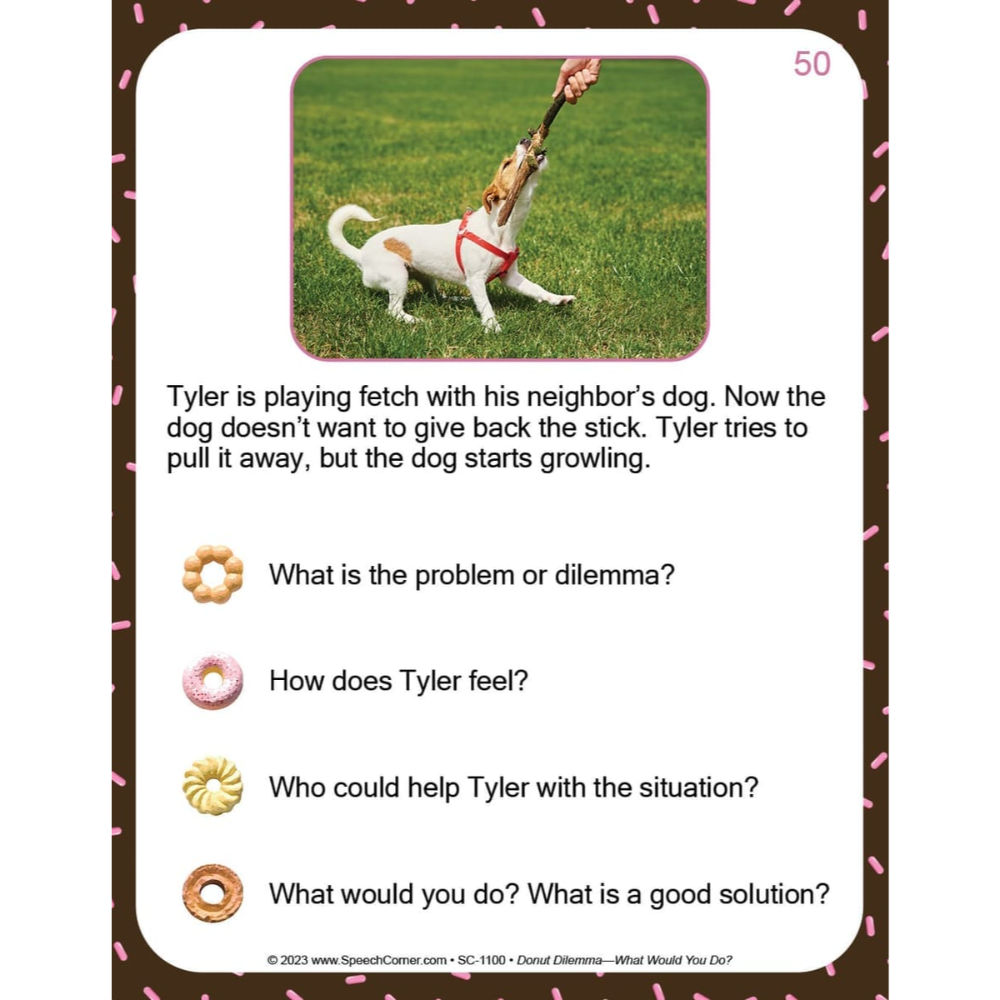
In Donut Dilemma, students take turns rolling the die, answering a problem-solving question, and stacking a plastic donut onto a wobbly saucer, working together to build the tower without letting it topple. The game comes with 50 content cards, and each of the four donut types targets one part of thinking through a dilemma.
What each donut targets:
- Ring donuts: identify the problem or dilemma
- Yeast donuts: explore how the character feels
- Cruller donuts: consider who or what could help
- Old-fashioned donuts: decide whether a solution is a good one
How to play:
- Set out the donuts, saucer, cup, and tongs, and place the cards within reach.
- A player rolls the die.
- The die shows a donut type, so the player takes a matching card.
- The player answers the problem-solving question on the card.
- After answering, the player uses the tongs to add that donut to the tower.
- Play continues cooperatively until the group builds the tower without it toppling.
Who is this problem-solving game helpful for?
Donut Dilemma is ideal for Speech-Language Pathologists (SLPs), special educators, and classroom teachers, and it fits social skills groups and social language intervention. It suits students in grades 1 through 6 who are developing problem-solving, perspective-taking, and reasoning. The game works in individual therapy, small group sessions, and classroom activities, and companion card sets are available to extend it into inferencing, comprehension, and figurative language.
Why Speech-Language Pathologists (SLPs), special educators, and teachers love this game:
The four donut types break a dilemma into clear steps, so you can target naming the problem, reading feelings, finding help, and evaluating a solution one at a time or together. The cooperative build removes the pressure of winning and losing while keeping students engaged, and the wobbly-saucer suspense holds attention across a full deck. Developed by Rachele Ellsworth, M.S., CCC-SLP.
Donut Dilemma: What Would You Do? includes:
- 12 plastic donuts
- 1 wobbly saucer
- 1 cup
- Tongs
- Die
- 50 content cards